Are Tarot Card Meanings Fixed or Do They Change?
- Know Thyself
- Mar 9
- 5 min read

Updated: Mar 26
One of the most common questions beginners ask when learning tarot is this: Are tarot card meanings fixed, or do they change depending on the reading?
If you’ve ever looked up a tarot card and found several different interpretations, you’re not alone. A single card can appear to mean many things depending on where you look. For someone learning how to read tarot cards, this can feel confusing at first.
The truth is that tarot card meanings are not completely fixed, but they are not random either. Tarot interpretation works through a balance between established meanings, context, symbolism, and the reader’s understanding of the situation.
Think of tarot as a language. Like any language, it has structure and vocabulary, but how those words are used changes depending on the conversation.
Understanding this balance is one of the most important steps in developing confidence in tarot reading for beginners.
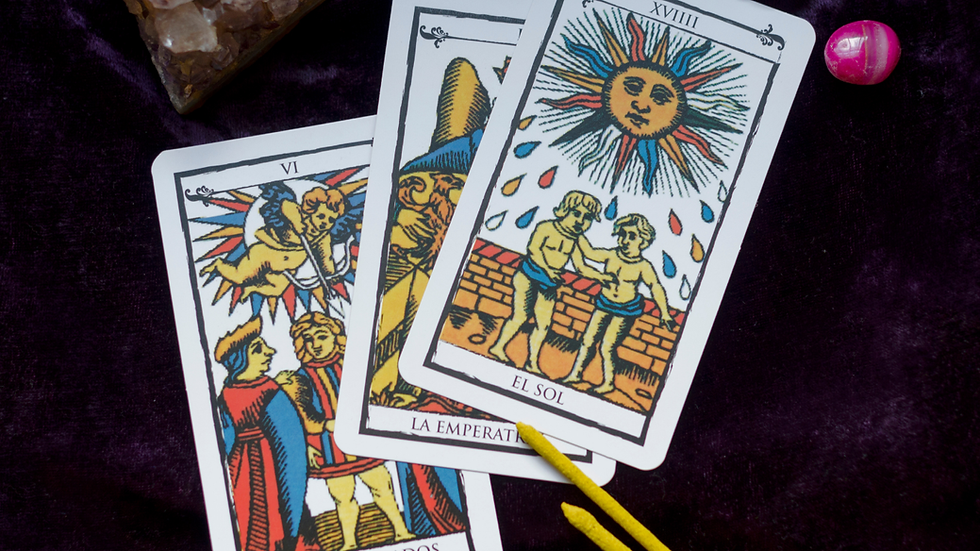
Traditional Meanings: The Foundation of Tarot
Every tarot card comes with traditional meanings that have developed over centuries. These meanings form the foundation of tarot interpretation and provide a starting point for readers.
For example:
The Fool is commonly associated with beginnings, curiosity, and taking a leap of faith.
The Lovers often represents relationships, choices, and alignment of values.
The Devil is traditionally linked with attachment, temptation, unhealthy patterns, or feeling trapped.
These shared meanings exist because tarot has been studied, practiced, and discussed by readers for generations. When you learn tarot, you are essentially learning this symbolic vocabulary.
For beginners, studying traditional tarot card meanings is extremely helpful because it gives you a reliable framework. Without this foundation, interpretation can become vague or inconsistent.
However, these meanings are only the starting point. What a card represents in a specific reading depends heavily on context.
Context in a Tarot Reading
In real readings, tarot cards rarely appear alone. They appear within a spread, a question, and a combination of surrounding cards.
This context shapes how the card should be interpreted.
For example, imagine pulling The Devil in two different situations.
Example 1: The Devil With the Ten of Cups
If The Devil appears next to the Ten of Cups in a relationship reading, it might suggest:
emotional dependency
a relationship that feels good but contains unhealthy attachments
difficulty letting go of something that appears happy on the surface
The positive emotional tone of the Ten of Cups modifies how we interpret the Devil.
Example 2: The Devil With the Five of Pentacles
Now imagine The Devil appears next to the Five of Pentacles.
In this context, the message may shift toward:
feeling stuck in a difficult financial or emotional situation
believing there is no way out
internalized limitation or fear
The surrounding card changes the interpretation significantly.
This is why learning tarot interpretation involves more than memorizing definitions. It requires understanding how cards interact with each other within a reading.
Imagery and Symbolism in Tarot Decks
Another factor that influences tarot interpretation is the imagery and symbolism in the deck itself.
Most modern decks are based on the Rider–Waite–Smith tradition, but artists often reinterpret the symbols in subtle ways. These visual choices can highlight different aspects of a card’s meaning.
For example, consider The Chariot.
In many decks, the Chariot depicts a figure riding a chariot pulled by two animals moving in different directions. Sometimes they are sphinxes, horses, or other symbolic creatures.
Key symbolic elements often include:
two opposing animals, representing opposing forces
a driver holding control, symbolizing discipline and direction
armor or protective clothing, suggesting strength and determination
These symbols reinforce the card’s traditional meaning: movement through control, focus, and determination.
When learning tarot symbolism, paying attention to these visual cues can deepen your understanding of the card beyond memorized keywords.
Reader Intuition and Interpretive Synthesis
A tarot reading is not just a collection of meanings. It is a process of interpretive synthesis, where the reader combines several layers of information at once.
Most experienced readers consider multiple elements simultaneously:
traditional meanings of the card
the question being asked
the spread position
surrounding cards
symbolism in the imagery
From these layers, the reader forms a coherent interpretation.
This process is sometimes called intuition, but in practice it is usually pattern recognition developed through experience.
For beginners, intuition often grows naturally as they practice. The more readings you do, the easier it becomes to see how the pieces fit together.
Rather than forcing yourself to “be intuitive,” it helps to focus on observing patterns between cards and situations.
Tarot as a Language: Structured but Flexible
A helpful way to understand tarot meanings is to think of tarot as a language.
In language:
words have established definitions
grammar provides structure
context changes meaning
For example, the word light can mean illumination, something not heavy, or even understanding, depending on the sentence.
Tarot cards work in a similar way.
Each card has a core meaning, but its interpretation shifts depending on the surrounding “sentence” created by the spread and the question.
This perspective helps beginners understand that tarot card meanings are structured but flexible.
You are not inventing meanings randomly, but you are also not restricted to a single rigid definition.
A Rule Many Professional Tarot Readers Follow
Many experienced tarot readers follow a simple guideline:
Start with the traditional meaning, then adjust based on context and symbolism.
This approach keeps readings grounded while allowing for nuanced interpretation.
A typical interpretive process might look like this:
Identify the card’s traditional meaning.
Consider the question being asked.
Look at the position of the card in the spread.
Examine the surrounding cards.
Observe the symbolism in the imagery.
By layering these elements together, the meaning becomes clearer and more relevant to the situation.
This method is especially useful for those practicing tarot reading for beginners, because it provides structure while encouraging deeper observation.
Final Thoughts
So, are tarot card meanings fixed?
Not exactly.
Tarot meanings have a stable foundation built from tradition, but they are designed to be interpreted within context. The question asked, the spread used, the surrounding cards, and the symbolism in the deck all influence the final message.
Learning how to read tarot cards is less about memorizing definitions and more about understanding how these layers interact.
Over time, this process becomes easier and more intuitive.
A helpful question to reflect on during your next reading is this:
How does the meaning of this card change when I look at the cards around it?
That single question can open the door to a much deeper understanding of tarot interpretation.
Join the Tarot Circle Workshop
If you feel curious about tarot or want to explore it in a deeper and more meaningful way, you are welcome to join The Tarot Circle Workshop.
The Tarot Circle is a relaxed and supportive space where we explore tarot beyond surface-level interpretations. Instead of simply memorizing meanings, we focus on learning how to read the cards with clarity, intuition, and understanding.
During the workshop, we explore:
How to interpret tarot with confidence
The symbolism and visual language within the cards
Practical reading techniques
How tarot can support reflection, insight, and self-awareness
The Tarot Circle is open to both beginners and experienced readers who want to deepen their relationship with tarot in a thoughtful and grounded way. ✨ If you would like to explore tarot in a more interactive and supportive environment, you are welcome to join the next Tarot Circle workshop.


Comments